

Two different things are called Guardrails. The Guardrails instructions field on this page holds behavioral rules you write for the AI agent. The separate Guardrails page covers abuse protection: rate limits, spam detection, and country blocking.
Instructions
Instructions define your AI agent’s behavior, role, and response guidelines. Use them to provide context, set expectations, and control how your AI agent responds to users. Go to Build > Instructions. The instructions editor fills the left of the page, and the Model configuration panel on the right holds the Model dropdown and the Temperature slider. Use Compare in the header to test changes side by side, and Save changes to apply them.Saving puts your changes in a draft. Your customers see them once you click Publish in the top-right corner. A few settings go live as soon as you save. See Drafts and versions.
General instructions
The General section contains your AI agent’s primary instructions. Use this section to define:- Your business or product context
- The AI agent’s role and responsibilities
- Response style and tone
- Goals and expected behavior
- Any additional guidance the AI agent should follow
utm_source? See UTM Tracking for the instructions to add.
Guardrails instructions
Use Guardrails to define rules your AI agent should always follow. Examples include:- Restricting topics the AI agent can discuss
- Preventing the disclosure of sensitive information
- Defining safety or compliance requirements
- Controlling fallback behavior
- Limiting the AI agent’s role or capabilities
Instruction examples by use case
Good instructions name the business, the AI agent’s job, what it should and shouldn’t do, and what to say when it doesn’t know. Replace the sample company details below with your own.- Customer support
- Sales
- Ecommerce
GeneralGuardrails
AI Model
The AI model is the specific machine learning model used to generate responses for your AI agent. Each model has different capabilities, performance characteristics, and message credit cost, so you can choose the one that best fits your needs.Auto (Chatbase)
Auto (Chatbase)
Auto adapts to every conversation, giving instant answers for everyday questions and frontier-grade intelligence for demanding ones. Multilingual and image understanding are built in, and it handles tools end to end.
- Auto: 1 message credit
GPT
GPT
- GPT-6.1 Sol: 2 message credits
- GPT-6.1 Terra: 2 message credits
- GPT-6 Luna: 1 message credit
- GPT-5.6 Terra: 2 message credits
- GPT-5.5: 4 message credits
- GPT-5.2: 2 message credits
- GPT-OSS-120B: 1 message credit
- GPT-OSS-20B: 1 message credit
Claude
Claude
- Claude 5.5 Opus: 5 message credits
- Claude 5.5 Sonnet: 2 message credits
- Claude 5.5 Haiku: 1 message credit
Gemini
Gemini
- Gemini 3.8 Flash: 2 message credits
- Gemini 3.6 Flash: 2 message credits
- Gemini 3.5 Flash Lite: 1 message credit
- Gemini 3.1 Pro: 2 message credits
- Gemini 3.1 Flash Lite: 1 message credit
- Gemini 3 Flash: 1 message credit
- Gemini 2.5 Pro: 2 message credits
DeepSeek
DeepSeek
- DeepSeek-V4.1-Flash: 1 message credit
- DeepSeek-V4-Flash: 1 message credit
- DeepSeek-V3.1: 1 message credit
- DeepSeek-R1: 1 message credit
Grok
Grok
- Grok 4.7: 2 message credits
Mistral
Mistral
- Mistral Medium 3.5: 2 message credits
- Mistral Small 4: 1 message credit
When you choose a Mistral model, the main inference call that generates your AI agent’s response runs on servers in the EU. Other steps involved in producing and delivering the reply may still be processed outside the EU, so selecting a Mistral model does not by itself keep all conversation data in the EU.
Kimi
Kimi
- Kimi K2.6: 1 message credit
GLM
GLM
- GLM 5.3 Flash: 1 message credit
- GLM 5.2: 2 message credits
Temperature
Temperature controls how creative and varied your AI agent’s responses are. The setting ranges from 0 to 1 and directly affects response predictability:- Lower temperature (close to 0): Produces focused, consistent responses by selecting the most probable outputs
- Higher temperature (closer to 1): Generates more creative and varied responses with less predictability
The default temperature is 0. Adjust it to experiment with different response styles and find what works best for your use case.
How temperature changes answers
Temperature changes how an answer is worded, not what the AI agent knows. Suppose a customer asks “What are your opening hours?” and your Data Sources say you’re open 9 AM to 6 PM, Monday to Friday:- At 0, the AI agent gives much the same answer each time: “We’re open Monday to Friday, 9 AM to 6 PM.”
- Near 1, the wording changes from one conversation to the next: “Happy to help! You can visit us any weekday between 9 in the morning and 6 in the evening.”
Compare area
Click Compare in the Build > Instructions header to open the compare view.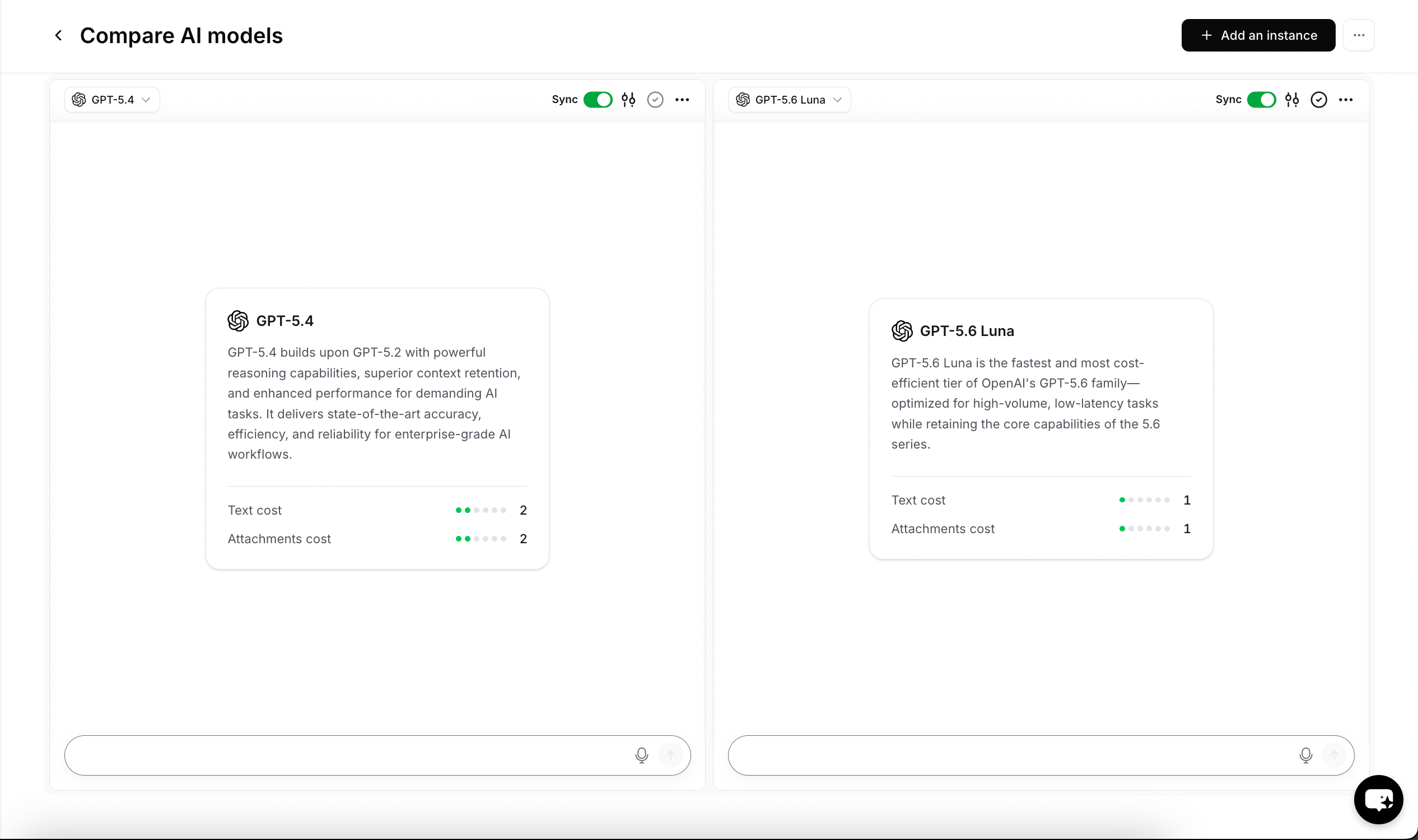
Per-agent controls
Each chat box in the compare view has its own controls, from left to right: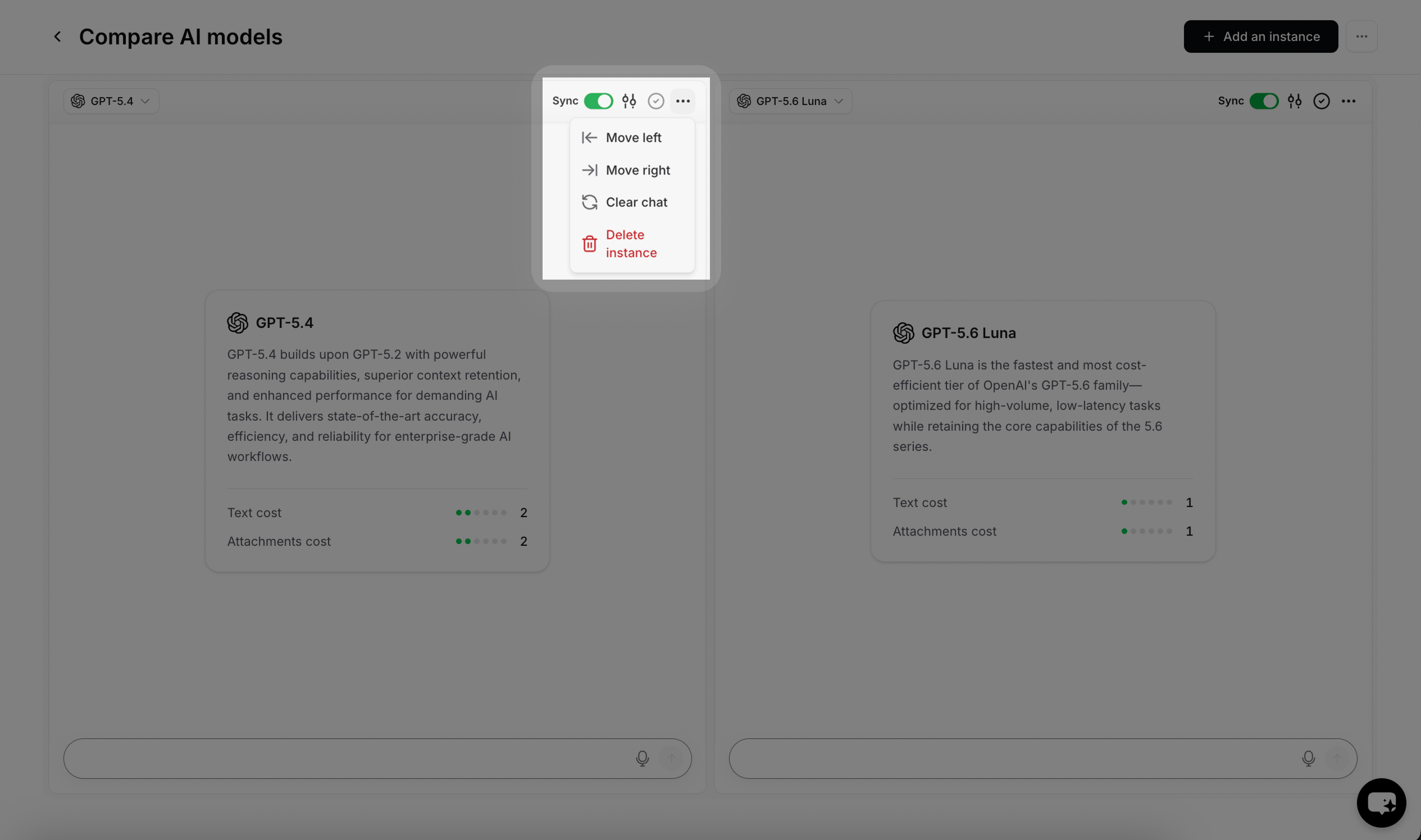
View controls
You can also:- Clear all chats
- Reset the AI agent’s settings to the main settings
- Add a new AI agent to test with
- Click the filter icon to change which AI models you’re testing, and select a new model from the dropdown
Send the same question to two or three models at once and compare the answers before you commit to one in Model configuration.
Troubleshooting
Frequently asked questions
What's the difference between instructions and Procedures?
What's the difference between instructions and Procedures?
Instructions apply to every conversation: the AI agent’s role, tone, scope, and rules. A Procedure applies only when a conversation matches its trigger, and gives the AI agent an ordered list of steps to follow, including the Actions to call. Use instructions for how your AI agent behaves in general, and Procedures for situations like refunds or order issues where you don’t want it improvising.
How long can my AI agent's instructions be?
How long can my AI agent's instructions be?
Instructions can be up to 30,000 characters, whether you write them in the dashboard or set them through the Chatbase API. Shorter instructions are easier to maintain: put facts like prices and policies in your Data Sources, and keep instructions for behavior.
Can each channel have different instructions?
Can each channel have different instructions?
Yes. In the Playground, the Overview tab of each channel has Sync with global instructions. Leave it on to use the instructions from Build > Instructions, or turn it off to write instructions for that channel only.
Why don't my instruction changes show up for customers?
Why don't my instruction changes show up for customers?
Saving puts your changes in a draft. The Playground uses the draft right away, but your live channels keep the published version until you click Publish. See Drafts and versions.
Which AI model should I choose?
Which AI model should I choose?
If you’re not sure, start with Auto, which uses 1 message credit per reply and adapts to each conversation. To compare specific models, send the same questions to several of them in Compare, and see Models comparison for each model’s strengths.
Should I put rules in General or Guardrails?
Should I put rules in General or Guardrails?
Put context and everyday behavior in General: your business, the AI agent’s role, tone, and goals. Put non-negotiable rules in Guardrails, such as topics to avoid, information never to share, and compliance requirements. The Guardrails instructions field is different from the Guardrails page, which covers rate limits, spam detection, and country blocking.
Next steps
Data Sources
Add and manage the content your AI agent is trained on.
Models comparison
See how the available models differ before you commit to one.
Best Practices
Proven ways to improve your AI agent’s answers.
Playground
Preview the effect of your changes the way a visitor will see them.